Article Scheduling around Florida weather delays.
Florida weather does not read the construction schedule. A foundation pour planned for Tuesday may move to Thursday. Roof framing can lose a day to thunderstorms. Exterior work may slow after heavy rain. A sequence of afternoon storms can shift several trades and inspections farther down the calendar. For a new-home buyer trying to schedule a phase inspection, that can be frustrating. But there is one important rule that makes the process much easier: schedule around the construction stage, not the original date.
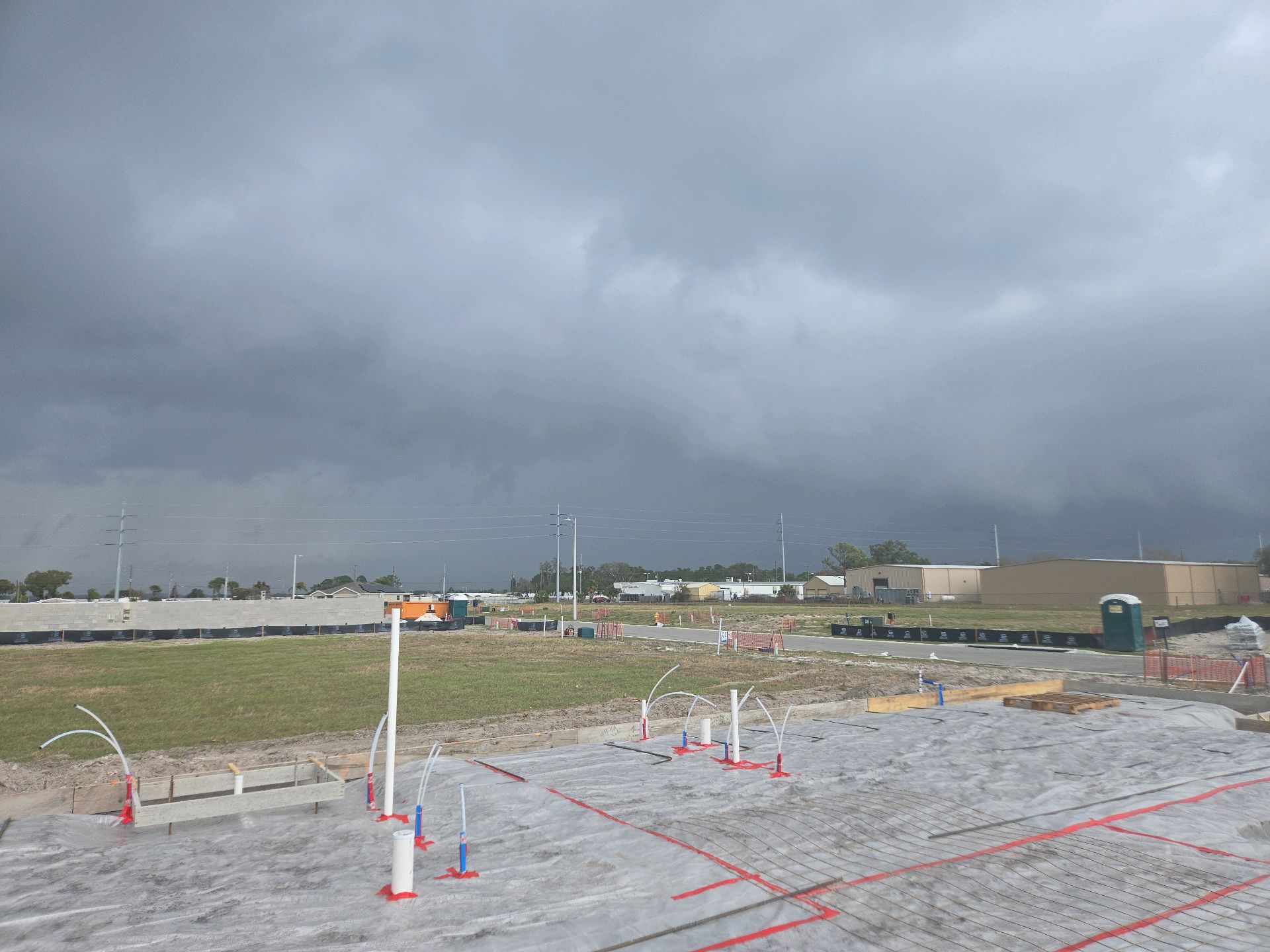
Construction schedules move
When your builder gives you an estimated date for the next construction milestone, treat it as exactly that: an estimate. Weather is only one reason construction schedules change. Material deliveries, subcontractor availability, required building inspections, corrections, engineering questions and the completion of previous work can all affect when the next stage actually begins.
In Florida, weather adds another variable. The National Weather Service identifies a distinct thunderstorm season across much of the state, with frequent lightning and periods of heavy rainfall during the warmer months.
Sometimes the delay is obvious. Other times, one lost afternoon moves a trade into the next day, which moves another trade, which changes an inspection, which ultimately changes when the home is ready for your phase inspection. A one-day weather delay does not always remain a one-day schedule change.
The inspection window matters more than the calendar
For Home IQ, the important question is not "What date did the builder originally give us?" It is "Is the home ready for this inspection?" Each phase inspection has a particular window when the components we need to observe are accessible.
- Pre-slab. Foundation preparation and applicable in-slab components need to be sufficiently complete for evaluation, but the concrete cannot already have been placed.
- Pre-drywall. The applicable framing and rough building systems need to be sufficiently complete, but insulation and drywall cannot have concealed the work we need to see.
- Pre-closing. The home should be sufficiently complete for its systems, components, fixtures, finishes, doors, windows and other accessible areas to be meaningfully evaluated.
The date matters. The stage matters more.
Rain before a concrete pour can change the schedule quickly
Pre-slab inspections deserve particular attention because the inspection window can be short. Forms may be ready. Reinforcement may be installed. The vapor barrier and in-slab components may be in place. The builder may anticipate concrete the following morning. Then significant rain arrives.
Site conditions can change, work may need additional preparation, a required inspection may move, or the concrete placement itself may be rescheduled. That does not necessarily mean anything is wrong. It means the construction sequence changed. The private inspection should move with it.
What we do not want is to inspect too early simply because that was the original appointment date, or to arrive after the concrete has already concealed the components we were supposed to inspect.
Where it fits. The pre-slab inspection is the shortest window of the four. Tell us when your build is nearing slab, and keep us posted as the pour date firms up. What a torn vapor barrier costs later is the reason the window is worth protecting.
Pre-drywall can move too
Pre-drywall usually provides a somewhat larger scheduling window, but weather can still affect it. Roof dry-in, framing work, exterior openings, mechanical work, electrical rough-in, plumbing rough-in, required building inspections and other construction activities may need to reach the appropriate stage before the home is ready.
Florida's required building inspections are themselves part of the sequence. The Florida Building Code requires inspections at specified construction phases, and work subject to inspection cannot simply be concealed before the applicable required inspection has occurred. So if earlier construction activity moves, the pre-drywall date can move with it.
Again, the objective is not to protect an appointment on the calendar. It is to protect the inspection opportunity.
Do not rush an inspection just to keep the original date
There is limited value in inspecting a construction phase before enough of the work is complete. If major portions of the rough electrical, plumbing, mechanical or framing work are still underway, an inspector may be evaluating an incomplete installation. That creates an obvious limitation: something that has not been installed yet cannot be inspected.
The opposite problem is waiting too long. Once work is concealed, visibility is lost. The goal is therefore not simply to schedule the inspection as early as possible. It is to schedule it at the right point in construction.
Communication with the construction manager matters
The homeowner usually does not control the builder's construction schedule. That is why communication with the construction manager is important. As the anticipated inspection approaches, confirm that the home is still on track.
- Has the concrete pour changed?
- Are the rough trades complete?
- Have the required building inspections occurred or been scheduled?
- Is insulation going in tomorrow?
- When is drywall expected to begin?
Those updates are far more useful than relying on a construction calendar that may have been created weeks earlier.
Local building inspections have scheduling requirements of their own. For example, the City of Orlando requires permitted projects to receive inspections at various stages and provides separate procedures for scheduling, rescheduling, cancellations and reinspections. Those regulatory steps can affect when subsequent construction proceeds.
How we handle it. We coordinate access directly with your construction manager rather than putting you in the middle of scheduling, and we move with the build when the build moves. How we work with builders.
A weather delay is not necessarily a problem
Buyers naturally become concerned when they hear that construction has been delayed. But a weather delay by itself does not mean something has gone wrong with the home. Sometimes waiting is exactly what the construction process requires.
The more useful question is whether the builder appropriately adjusts the construction sequence and whether the next phase proceeds when conditions and preceding work are ready. From an inspection standpoint, our concern is simpler: do not let a changing schedule cause you to miss the stage.
Give yourself some flexibility
If you are planning phase inspections on a new home, especially during Florida's wetter months, avoid treating estimated construction dates like fixed appointments.
- Stay in contact with your construction manager.
- Ask for updates as major milestones approach.
- Let your inspector know when dates begin moving.
- Whenever possible, confirm that the construction stage is ready before locking in the inspection.
At Home IQ, we understand that new-construction schedules change. Our objective is not to make the construction schedule fit our calendar. Our objective is to be there while the work you hired us to inspect is still visible.
Follow the build, not the forecast
Weather is part of building in Florida. Some weeks cooperate. Others do not. A construction schedule may move several times between foundation and closing, and that alone is not unusual. What matters to the homeowner is preserving the opportunity to see important stages before construction moves beyond them.
The date can change. The inspection window should not be missed.
Because even a new home deserves a second set of eyes.
Dates moving?
Tell us as soon as they do. We hold the slot to the stage, not the calendar, and we would rather move three times than miss the window once.