Article Stucco cracking in Central Florida and when it matters.
Walk around enough new homes in Central Florida and eventually you will see it. A thin crack running across a stucco wall. A hairline near a window. A small crack extending from the corner of an opening. The immediate question is usually the same: should I be worried? The answer depends on more than whether a crack exists. Stucco is a cement-based material, and cracking can occur for several reasons as materials cure, dry, move and respond to environmental conditions. Some cracking may be relatively minor. Other cracks deserve closer attention because of their width, location, pattern, associated conditions or evidence of continued movement. The important part is knowing the difference.
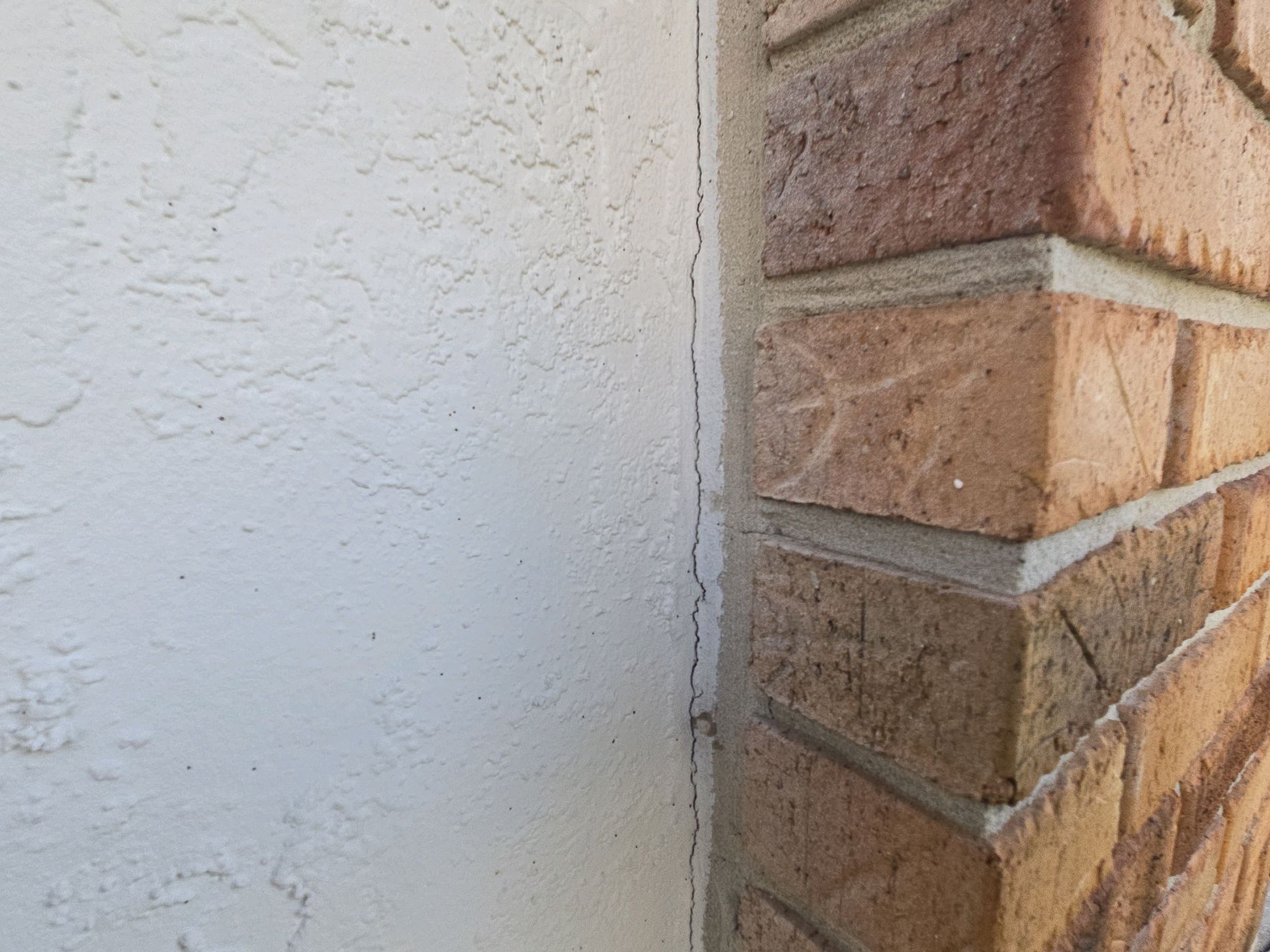
Why stucco cracks
Stucco is rigid, but the building behind it is not completely motionless. Construction materials expand, contract, dry, shrink and respond to temperature and moisture. The wall assembly supporting the stucco can also experience movement. The stucco itself changes as it cures.
Florida stucco industry guidance recognizes several potential contributors to cracking, including plastic shrinkage during curing, drying shrinkage as excess moisture leaves the material, environmental conditions during application and curing, movement of the supporting structure, and the design and placement of control joints.
Central Florida adds its own environment to the equation: heat, sun, rain, humidity and significant changes in surface temperature. That means the existence of a crack alone does not tell us its cause or significance. We have to look at the crack in context.
Hairline cracks
Very fine surface cracks can occur as cement-based stucco cures and dries. These may appear individually or as very fine patterns across portions of the wall. Industry guidance describes crazing, for example, as a pattern of dense hairline cracking that can develop when moisture evaporates rapidly during curing.
A small, stable hairline crack does not automatically indicate a structural problem. But that does not mean it should simply be ignored. Exterior wall finishes are part of the home's weather-resistant exterior assembly. A crack should be evaluated based on its characteristics and location, particularly if it appears to provide a pathway for moisture or continues to change.
Location tells us something
Where a crack occurs can sometimes be just as important as its size. Windows and doors are areas we pay particular attention to. Openings interrupt an otherwise continuous wall, and stresses can concentrate around their corners. Cracks extending diagonally from window or door corners therefore deserve closer observation.
We also pay attention to cracking:
- At transitions between different building materials
- Around penetrations and exterior openings
- Near control or expansion joints
- Along long uninterrupted wall surfaces
- At building corners
- Where the crack appears wider at one end than the other
- Where multiple cracks form a recognizable pattern
- Where displacement is visible across the crack
None of those conditions automatically identifies the cause. They tell us where a closer look may be warranted.
Width matters, but it is not the only thing that matters
It is tempting to use a single crack width as the dividing line between "normal" and "problem." Buildings are not that simple. A very fine crack that remains unchanged may have considerably different significance from a crack that is widening, reopening after repair, allowing moisture entry, or occurring alongside other evidence of movement. Likewise, the same size crack can mean different things depending on where it occurs and what is happening around it.
That is why Home IQ does not evaluate stucco cracking based solely on a ruler. We consider the visible condition as a whole.
What is happening around the crack?
A crack rarely gets evaluated in isolation. During an inspection, we also look for related visible conditions.
- Is there staining?
- Is the stucco loose or displaced?
- Does tapping the surrounding area suggest separation from the substrate?
- Is sealant around a nearby window or penetration incomplete?
- Are there gaps where different materials meet?
- Does the crack continue through another component?
- Are there similar cracks elsewhere on the same wall?
- Is there evidence that the area has already been repaired and cracked again?
Those observations provide context. A crack accompanied by other visible conditions may warrant a different recommendation than an isolated, stable hairline crack.
Water changes the conversation
One of the reasons exterior cracking matters is moisture. Stucco is part of an exterior wall assembly designed to manage exposure to weather. Properly installed flashing, water-resistive components, sealants, drainage provisions and other details work together with the exterior finish.
A crack does not automatically mean water is entering the home. But when cracking occurs near windows, doors, penetrations, flashing transitions or other vulnerable areas, the surrounding installation deserves attention. Florida's building environment makes water management particularly important.
The question becomes more than "Is the crack structural?" It is also "Could this condition affect the wall's ability to manage water?"
See it. The deficiency library shows the cracking patterns that get documented at month 11, and the unsealed penetrations and exposed stucco edges that often sit near them.
Cracking in a new home deserves documentation
There is another advantage to identifying stucco cracking during new construction or during the builder's warranty period. You establish a record. Photographs document the crack's location and appearance at a specific point in time. That gives the homeowner something valuable later: a reference.
If the crack remains unchanged, that history provides useful context. If it becomes wider, longer, develops displacement, reappears after repair, or is joined by additional cracking, there is documentation showing how the condition has changed. Without that reference, homeowners are often left wondering, "Was that crack always this big?"
Repairing the surface is not always the same as addressing the cause
A crack can often be patched or coated. But if the crack resulted from an underlying condition that remains active, repairing only the visible surface may not prevent it from returning. That does not mean every stucco crack requires an extensive investigation. It means the appropriate response should match the condition.
For relatively minor cracking, the builder may determine that sealing or surface repair is appropriate. Where cracking is wider, displaced, recurring, associated with moisture, or suggestive of movement in the underlying assembly, further evaluation may be appropriate before simply covering it.
So when does a stucco crack matter?
A crack deserves additional attention when its characteristics suggest there may be more happening than ordinary surface shrinkage. That may include cracking that is widening or changing, recurring after repair, showing displacement, occurring in a significant pattern, associated with moisture-related conditions, or accompanied by other indications of movement or installation concerns.
The goal is not to label every crack a structural problem. And it is not to dismiss every crack as "normal." The goal is to understand what the crack is telling us.
Do not just look at the crack. Look at the story around it.
Stucco cracking is common enough that homeowners can easily become accustomed to seeing it. But common and insignificant are not necessarily the same thing. The size of the crack matters. Its location matters. Its pattern matters. What is happening around it matters. And whether it is changing over time matters.
During a new-construction inspection or 11-month warranty inspection, documenting those conditions gives the homeowner an opportunity to have them evaluated while the builder is still involved.
Where it fits. The exterior is walked at pre-closing, when the stucco is new, and again at the 11-month inspection, after the house has been through a full year of heat, humidity and rain. Cracks documented at both visits give you a before and after, and a written record to hand the builder before the warranty year ends.
A crack is a condition. The context tells us whether it may be a concern.
Because even a new home deserves a second set of eyes.
Coming up on a year?
Book the 11-month inspection with time to spare. The report needs to reach your builder before the warranty year closes, and cracks documented now are on the record while the warranty year is still open.